Clean Architecture Introduction: Why It’s the Heart of Scalable Apps
In the world of software engineering, writing code that “just works” is easy. However, writing code that remains maintainable, testable, and scalable as the project grows is the real challenge. Welcome to the first part of our series: a deep dive into Clean Architecture Introduction.
The Problem: The “Big Ball of Mud”
Most developers start a project by putting everything—UI logic, business rules, and database calls—into a single place. In Flutter, we often see this as “Massive Controllers” or “Logic in the UI.” While this works for small apps, it becomes a nightmare when:
- The business logic changes.
- You want to switch from a REST API to GraphQL.
- You need to write unit tests but can’t because everything is tightly coupled.
The Solution: What is Clean Architecture?
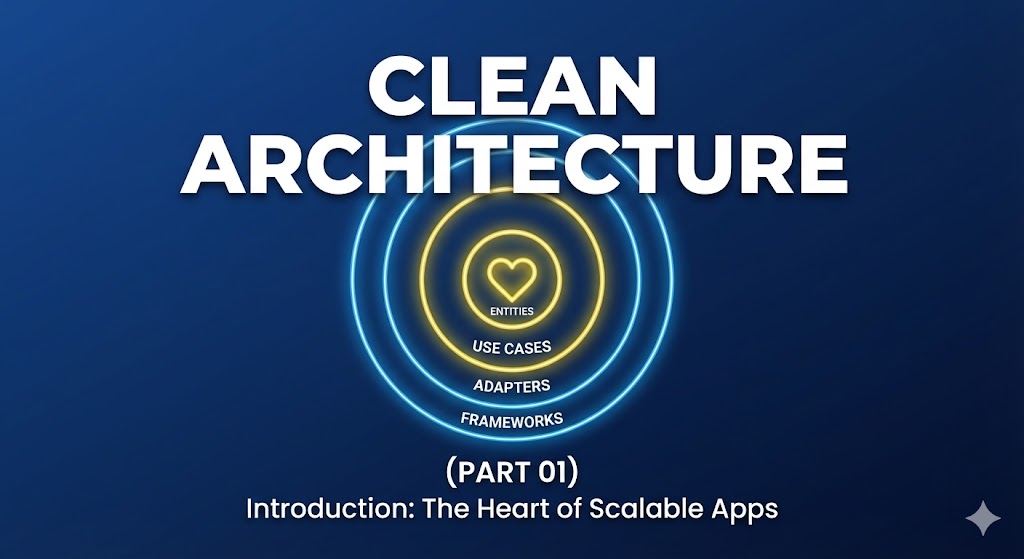
Proposed by Robert C. Martin (Uncle Bob), Clean Architecture is a philosophy of software design that separates the elements of a design into ring-like levels. The core rule is the Dependency Rule: Source code dependencies can only point inwards.
Nothing in an inner circle can know anything at all about something in an outer circle.
The Core Layers
- Entities: The business objects of your application. They encapsulate the most general and high-level rules.
- Use Cases: These contain application-specific business rules. They orchestrate the flow of data to and from the entities.
- Interface Adapters (Repositories/Presenters): This layer converts data from the format most convenient for the use cases to the format most convenient for external agencies like the Web or Database.
- Frameworks & Drivers: This is where the “details” live—your UI, your Databases, and your HTTP clients.
Why Should You Care?
By following this Clean Architecture Introduction, you ensure that:
- Your UI is independent: You can swap Flutter for another framework without touching the business logic.
- Your Database is independent: You aren’t tied to SQL or NoSQL.
- The system is Testable: You can test business rules without the UI, Database, or Server.
Conclusion
Clean Architecture isn’t just about folder structures; it’s about freedom. It gives you the freedom to postpone decisions about databases or UI frameworks until the very last moment.
In the next article, we will dive into the very center of the “onion”—Entities.
Link to Uncle Bob’s Original Blog for authority.